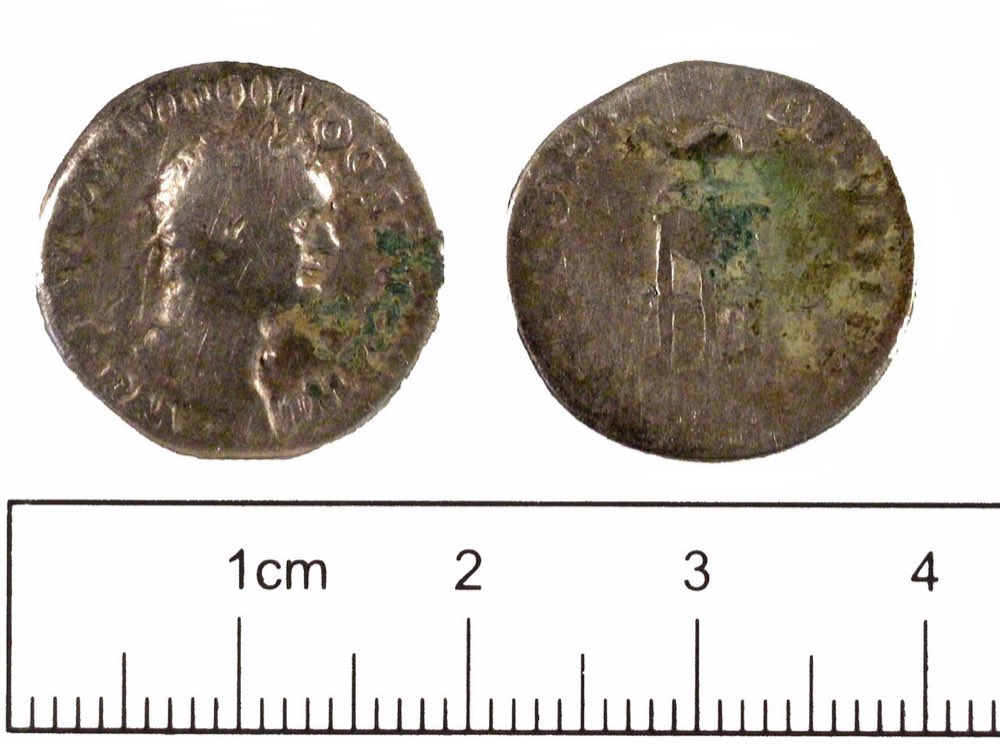
Roman coins are among the most common old finds in Britain. Rome ruled here for nearly four hundred years, and its army, towns and villas used coins in enormous numbers. Most of what comes out of the ground is small, worn bronze, but almost every one can be identified to a period, many to an emperor, and some to the exact mint and year.
This guide works through identification in the order an expert would: is it Roman, what denomination is it, whose head is on it, what is on the back, and when was it struck. Then it covers what to do with it, including the reporting rules, and the honest answer about value.
The short answer
- Roman coins usually show an emperor’s head facing right, with a Latin legend around the edge, and a design such as a god, personification or military scene on the reverse.
- Size, metal and headwear give you the denomination. A radiate (spiky) crown marks a coin worth double the basic unit in its period.
- The legend gives you the emperor. Look for the name, usually after abbreviated titles such as IMP, CAES or DN.
- Later coins carry a mint mark at the bottom of the reverse. Coins marked L, LN, PLN or PLON were struck in London.
- Record it with the Portable Antiquities Scheme. It is voluntary for single coins in England and Wales, and your Finds Liaison Officer can identify it for you.
- Groups of coins can be treasure: two or more silver or gold coins from the same find, or ten or more bronze ones.
Step 1: is it Roman?
Signs that point to a Roman coin:
- A portrait facing right, usually an emperor (sometimes an empress or a prince), wearing a laurel wreath, a radiate crown or, in the later period, a diadem.
- A Latin legend running round the edge, often heavily abbreviated.
- A struck, slightly irregular flan rather than the perfectly round blank of a modern coin.
- Green or brown patina on bronze coins; grey or black toning on silver.
Things that are often mistaken for Roman coins: medieval jetons (reckoning counters), 18th-century tokens, and modern replicas. Celtic coins - struck in Britain before and during the Roman conquest - have stylised horses and heads rather than a realistic portrait and Latin titles.
Step 2: work out the denomination
The metal, size and portrait crown together tell you what you have. These are the denominations most often found in Britain, broadly in date order.
Common Roman denominations found in Britain
Denarius - small silver coin, the standard silver piece of the early Empire, laureate head. Typical of the 1st and 2nd centuries AD.
Sestertius - large brass coin, the biggest everyday coin, often with "S C" on the reverse. 1st to 3rd centuries.
Dupondius and as - medium-sized bronze coins. The dupondius usually shows a radiate crown, the as a laurel wreath. 1st to 3rd centuries.
Radiate (antoninianus) - a coin with a radiate crown that began as silver in the early 3rd century and became almost pure bronze by the 270s. Very common as finds. Small, crude copies called "barbarous radiates" were also made locally in the later 3rd century.
Nummus - small bronze coin of the 4th century, often with a diademed head. The commonest Roman coins found on many sites.
Siliqua - thin, small silver coin of the 4th century.
Aureus and solidus - gold. Rare as single finds, and potentially part of something bigger.
One tip from the Portable Antiquities Scheme’s own recording guidance: the letters “S C” on early bronze coins stand for senatus consulto - by decree of the Senate - and are not a mint mark.
Step 3: read the legend and find the emperor
The obverse (head side) legend names the emperor, wrapped in abbreviated titles. The most common:
- IMP - imperator, commander.
- CAES - Caesar.
- AVG - Augustus.
- PF - pius felix, dutiful and fortunate.
- DN - dominus noster, our lord (mainly 4th century).
- P M, TR P, COS, P P - chief priest, tribunician power, consul, father of the fatherland. The numbers after TR P and COS can date a coin to a specific year.
The emperor’s name usually sits between these. IMP CARAVSIVS P F AVG, for example, is Carausius, the emperor who broke away and ruled Britain from AD 286 to 293 - a coin with special interest for British finders.
Worn coins rarely show the whole legend. Read what you can, letter by letter, and match the fragments against a catalogue. Two or three clear letters and the style of the portrait are often enough.
Step 4: read the reverse and the mint mark
The reverse (back) shows a design and usually a legend of its own: a god such as Jupiter or Mars, a personification such as Victory, Peace (PAX) or Hope (SPES), or military scenes. Some 4th-century reverses are so common they are recognisable at a glance - two soldiers standing either side of standards with the legend GLORIA EXERCITVS, or a soldier spearing a fallen horseman with FEL TEMP REPARATIO.
From the later 3rd century onwards, many coins carry a mint mark in the exergue, the strip below the main reverse design. It names the city where the coin was struck. Some to look for:
- L, LN, PLN, PLON - London.
- TR - Trier.
- LVG - Lyon.
- ARL, CONST - Arles.
- SIS - Siscia.
If you cannot read a mint mark, leave it blank - the PAS’s own guidance is not to guess.
Step 5: date it
Once you have an emperor, you have a date range. If you cannot identify the emperor, the denomination and style still narrow it down. The Portable Antiquities Scheme dates Roman coins into broad periods (known as Reece periods after the archaeologist who devised them) and, where a coin cannot be pinned down, records a range such as AD 260-296 rather than a guess. That is a perfectly respectable identification.
Step 6: record it, and know the treasure rules
Recording. In England and Wales, recording a single Roman coin with the Portable Antiquities Scheme is voluntary, but it is the best way to get an expert identification and adds to what is known about Roman Britain. Your local Finds Liaison Officer will identify it, photograph it and give it back. In Scotland, all archaeological finds must be reported under Treasure Trove.
Treasure. Under the Treasure Act 1996, coins over 300 years old are treasure when they come from the same find and there are:
- two or more coins that are at least 10 per cent gold or silver, or
- ten or more coins of lower precious-metal content, such as bronzes.
A single coin is not normally treasure. But since 2023, an object at least 200 years old that is partly metal can be treasure if it is of exceptional significance, so a remarkable single coin could qualify. Potential treasure must be reported to the coroner within 14 days. See our guide to what to do if you find treasure.
If you find several coins together, stop digging, note the spot, and contact your Finds Liaison Officer. A scatter of coins can be the edge of a hoard, and the context matters as much as the coins.
What is it worth?
Honestly, usually not much in money. Common worn bronzes - radiates and 4th-century nummi - are found in huge numbers and sell for little. Silver denarii and well-preserved bronzes of rarer emperors are worth more, and gold is a different matter entirely. Condition counts for a great deal.
For guide prices, the annual Coins of England and the United Kingdom catalogue runs from Celtic and Roman issues through to modern coinage, and specialist Roman coin catalogues cover the full range. Remember that a coin found on someone’s land generally belongs to the landowner unless you have agreed otherwise, which is why permission agreements usually include a finds split.
Do not clean it
The single most common way Roman coins are ruined is by cleaning. Chemical dips, wire brushes and abrasive pastes strip the patina and the surface detail you need to identify the coin, and wipe out most of any value. Let it dry, brush off loose soil with something soft, and leave the rest to an expert. Our guide to cleaning metal detecting finds explains why.
The kit
These are the tools and references that help most. They are taken from our other guides; we have not tested them specifically for coin identification.
The catalogue: Coins of England and the United Kingdom 2026 (about £28)
The standard annual catalogue for identifying and valuing British coins, from Celtic and Roman issues through hammered and milled coinage. Rated 4.7 stars from 43 reviews.
A magnifier: 10x hand lens
Most of identification is reading tiny, worn letters. A 10x lens and a bright lamp at a low angle will show detail you cannot see with the naked eye. We have not picked a single model; the link shows current options.
To protect it: clear coin capsules in six sizes (about £9)
Once a coin is dry and recorded, a capsule protects it and lets you see both sides without handling it. Rated 4.4 stars from 1,500 reviews.
To record where it came from: write-on grip seal bags (about £4.50 for 100)
Bag each coin in the field with the findspot. Without it, a coin loses most of its value to archaeology. 4.6 stars from 516 reviews.
Prices and ratings were last checked between October and November 2026 and will have moved.
Frequently asked questions
How do I know if a coin is Roman? Look for a portrait facing right, usually wearing a laurel wreath, radiate crown or diadem, with an abbreviated Latin legend round the edge and a figure or scene on the reverse. Medieval jetons and 18th-century tokens are the most common look-alikes.
What is the most common Roman coin found in Britain? Small bronze coins of the 3rd and 4th centuries AD - radiates and 4th-century nummi - are found in the greatest numbers on many sites.
How can I tell which emperor is on a Roman coin? Read the obverse legend. The emperor’s name sits among abbreviated titles such as IMP, CAES, AVG and PF. Even a few clear letters, combined with the portrait style and denomination, are usually enough to match it in a catalogue.
What do the letters at the bottom of a Roman coin mean? On many later coins they are a mint mark, naming the city that struck it: L, LN, PLN or PLON for London, TR for Trier, LVG for Lyon. On early bronzes, “S C” means “by decree of the Senate” and is not a mint mark.
Do I have to report a Roman coin? A single coin is not normally treasure in England, Wales or Northern Ireland, so reporting is voluntary, though recording it with the Portable Antiquities Scheme is strongly encouraged. Two or more gold or silver coins, or ten or more bronze coins, from the same find must be reported as potential treasure. In Scotland, all archaeological finds must be reported.
Are Roman coins worth anything? Most worn bronze Roman coins are worth very little in money because so many survive. Silver denarii and well-preserved coins of rarer emperors are worth more, and gold much more. Never clean a coin to improve it - that destroys value.
Should I clean a Roman coin? No. Cleaning removes the patina and detail you need to identify it and usually reduces its value. Brush off loose soil only and let an expert see it.