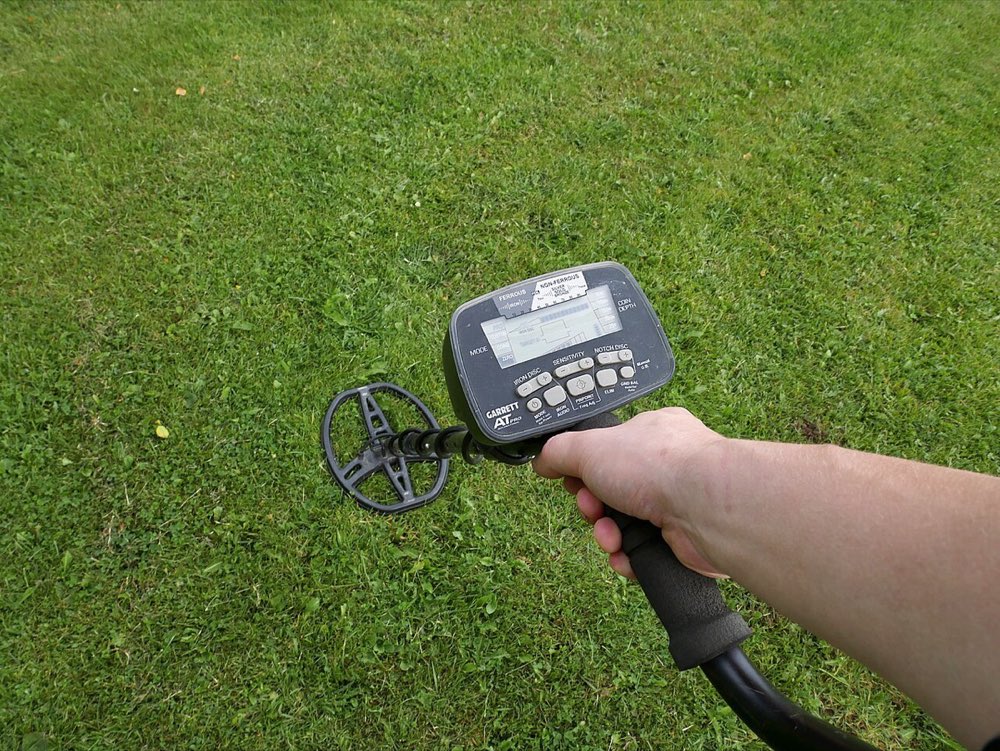
A metal detector works by sending a changing magnetic field into the ground from its search coil. That field makes tiny electric currents flow in any metal it reaches, those currents create a magnetic field of their own, and the detector picks that second field up and turns it into a sound and a number on the screen.
That is the whole trick. Everything else on a modern detector, from target ID to ground balance to multi-frequency, is about reading that faint return signal more cleverly. Understanding it will not find you a hoard, but it does explain why your machine behaves as it does, and which features are worth paying for.
The short answer
- The coil transmits a magnetic field that changes thousands of times a second.
- Metal responds. The field induces small circulating currents, called eddy currents, in any metal object.
- The coil receives. Those eddy currents make their own weak magnetic field, which the detector senses.
- The electronics interpret. The size and timing of the return signal hint at what the metal is and how deep it lies.
- You hear a tone and see a target ID number. The rest is practice.
Step by step
1. The search coil sends out a field
The round or oval coil at the bottom of the shaft holds wire windings. The control box drives an alternating current through them, which creates a magnetic field that spreads into the ground below the coil. On the most common type of hobby detector, known as VLF (very low frequency), this is a continuous wave in the kilohertz range.
2. Metal objects produce eddy currents
When that changing field passes through a coin, a ring or a rusty nail, it induces eddy currents in the metal. The better the metal conducts electricity, the stronger those currents. Silver and copper respond strongly. Size, shape and the angle the object lies at all change the response too, which is why a coin on edge is harder to find than one lying flat.
3. The coil picks up the return signal
Eddy currents generate a second, much weaker magnetic field. A VLF detector has a separate receive winding in the coil that picks this up. Because the receive winding is arranged to ignore the detector’s own transmitted field, even a tiny return from a small object stands out.
4. The control box works out what it is
The return signal is slightly delayed compared with the one sent out. That delay is called the phase shift, and it differs between metals. Iron behaves one way, a silver coin another. The detector measures the phase shift and the strength of the signal, compares them with known patterns, and gives you a target ID number and a tone.
This is also how discrimination works. If you tell the machine to ignore the range of readings that iron nails produce, it simply stays quiet for those.
Why the ground itself is a problem
Soil is not electrically invisible. Minerals in the ground, and salt on a wet beach, respond to the detector’s field too, and can drown out a small target or cause false signals. Ground balance is the setting that measures the ground’s own response and subtracts it. Most modern machines do this automatically or track it as you walk.
This is why a detector that is quiet and deep on dry pasture can chatter on a wet beach, and why beach modes exist. Our guide to detecting on UK beaches covers where you are allowed to try it.
What frequency does
The frequency is how many times a second the field changes direction, measured in kilohertz (kHz).
| Frequency | Good at | Less good at |
|---|---|---|
| Lower (about 4 to 5 kHz) | Larger, highly conductive targets such as big silver and copper coins | Tiny or thin targets |
| Middle (about 10 to 15 kHz) | General coin and relic hunting | Nothing in particular, which is why it is the usual default |
| Higher (20 kHz and above) | Small, thin or low-conductivity targets, such as fine gold and thin hammered coins | Depth on large objects, and it is noisier on mineralised ground |
A single-frequency detector makes you choose. The Minelab Equinox 700, for example, offers single frequencies of 4, 5, 10 and 15 kHz.
Multi-frequency
A simultaneous multi-frequency detector transmits several frequencies at once and combines the results. In practice that means it does not have to compromise between large and small targets, it identifies targets more reliably, and it copes much better with wet salt sand. It is the main reason a detector costs £200 rather than £80, and for UK ground it is the feature most worth paying for. Our buying guide explains which machines have it.
VLF and pulse induction
Almost every hobby detector sold in the UK is a VLF machine. The other main type is pulse induction (PI).
| VLF | Pulse induction | |
|---|---|---|
| How it transmits | A continuous wave | Short, powerful pulses |
| What it measures | Phase shift and strength of the return | How long the return takes to fade |
| Strengths | Affordable, and good at telling metals apart | Depth on larger objects, and it handles mineralised ground and salt water well |
| Weaknesses | More affected by mineralised ground | Poor at telling metals apart, and more expensive |
For fields and parks in Britain, VLF is the right tool. PI machines are specialist kit for gold fields abroad and deep beach work.
What decides how deep it goes
- Target size. A large object returns a stronger signal than a small one.
- Coil size. A bigger coil reaches deeper but is less sensitive to small targets and harder to pinpoint with.
- The ground. Mineralised or wet salty ground reduces depth.
- Frequency and settings. As above, and running the sensitivity too high in bad ground just adds noise.
Most coin-sized finds come from the top few inches. Our guide to how deep a metal detector can detect has realistic figures.
Three machines that show the differences
How we chose: from manufacturers’ specifications and Amazon UK prices and ratings. We have not tested these ourselves.
Multi-frequency on a budget: Minelab Vanquish 340 (about £199)
The cheapest new detector we recommend with simultaneous multi-frequency. A good way to see what the technology does for target ID without spending much. Our Vanquish 340 review covers who it suits.
Selectable single frequency, fully waterproof: Nokta Simplex Ultra (about £300)
Lets you choose the operating frequency for the job, and is waterproof to 5 metres. Our Simplex Ultra review has the detail.
A detector in miniature: Garrett Pro-Pointer AT (about £117)
A pinpointer is a tiny metal detector with the coil in its tip. It works on the same principle over a range of a few centimetres, to find the target once you have dug. Our pinpointer guide has cheaper options.
Prices were last checked on 10 November 2026 and will have moved.
Frequently asked questions
How does a metal detector work, simply? Its coil sends a changing magnetic field into the ground. Metal objects respond with a weak magnetic field of their own, and the detector senses that and beeps.
Can a metal detector detect all metals? Yes. Any metal that conducts electricity responds, including iron, gold, silver, copper, lead and aluminium. How strongly it responds depends on the metal, its size and its shape.
How does a metal detector tell gold from iron? By the phase shift, the small delay in the return signal, which differs between metals. It is an estimate, not a certainty. Gold and some junk, such as ring pulls and foil, read very similarly.
What does frequency mean on a metal detector? How many times a second the transmitted field alternates, in kilohertz. Lower frequencies favour large, highly conductive targets. Higher ones favour small or thin targets.
Is multi-frequency worth it? For most UK detecting, yes. It gives steadier target ID and works far better on wet beaches than a single frequency.
Why does my detector beep at nothing? Usually mineralised ground, electrical interference, or sensitivity set too high. Ground balance again and turn the sensitivity down a little.